Diagnostic
Your culture readiness profile
A structured self-assessment across six dimensions of culture and conduct readiness. For each dimension, you'll consider three statements and mark where your organisation stands today. It takes about five minutes and produces a profile you can download and share.
Designed for individual reflection or as a conversation starter with your leadership team. When used in a group, the disagreements are usually the most valuable part.
Your responses are anonymous. No personal information is collected unless you choose to share it with us.
How it works
Three steps. About five minutes.
- 01
Reflect
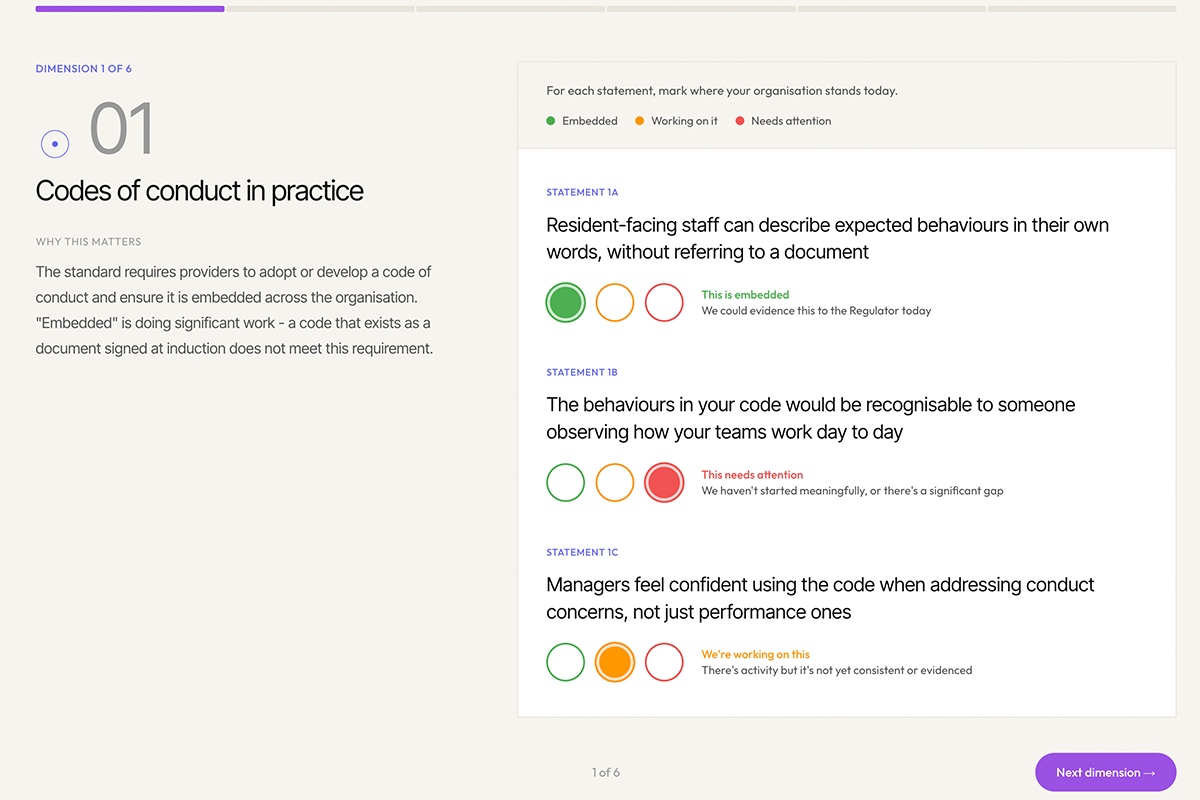
Six dimensions of culture readiness. For each one, you'll consider three statements about what “good” looks like in practice.
- 02
Rate
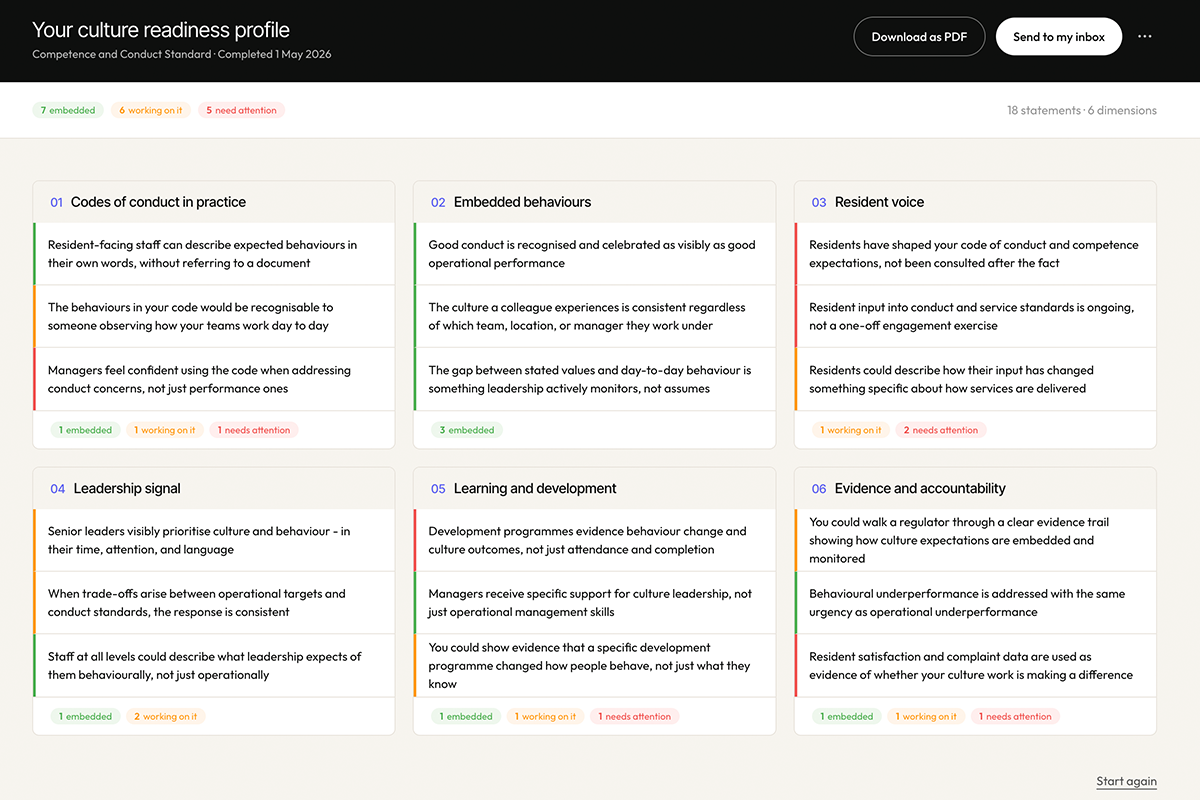
For each statement, mark where your organisation stands today: embedded, working on it, or needs attention. No scores — just an honest snapshot.
- 03
Share
Get a visual profile you can download as a PDF or send to your inbox. Designed to drop into a board pack or start a leadership conversation.
What it covers
Six dimensions of culture readiness
Each dimension is grounded in what the Competence and Conduct Standard specifically requires. The diagnostic asks three statements per dimension — eighteen in total.
- 01
Codes of conduct in practice
The standard requires providers to adopt or develop a code of conduct and ensure it is embedded across the organisation. "Embedded" is doing significant work - a code that exists as a document signed at induction does not meet this requirement.
- 02
Embedded behaviours
The standard asks providers to ensure behaviours are embedded, not just stated. There's a difference between having values on the wall and having systems that actively reinforce, recognise, and hold people to those values in practice.
- 03
Resident voice
The standard requires that residents have "meaningful opportunities to influence and scrutinise" your competence policy and code of conduct. Influence is a higher bar than consultation - it means shaping what gets built, not responding to something already designed.
- 04
Leadership signal
What leadership pays attention to, spends time on, and talks about communicates what matters more than any policy statement. The standard expects culture and conduct to be visibly led - not delegated to HR or treated as a compliance exercise.
- 05
Learning and development
The standard requires a written workforce development policy that connects learning to outcomes - not just skills acquisition. The gap between "we delivered the training" and "here's what changed because of it" is where most providers will need to do new thinking.
- 06
Evidence and accountability
The Regulator will take an outcomes-focused, assurance-led approach. That means the evidence trail matters - not as a compliance exercise, but as the way you demonstrate that culture work is genuine, embedded, and making a difference to residents.
In practice
Designed for team conversations
The diagnostic works well as individual reflection, but it's designed for teams. When a leadership group completes it independently and compares results, the disagreements are usually the most valuable part. Where your team diverges is where the real conversation starts.
Takes about five minutes. Three statements per dimension, eighteen in total.